

Received an Income Tax Notice Under Section 143(2) for AY 2025-26? Here’s What It Means and What You Should Do

Many taxpayers have recently received the following communication from the Income Tax Department:
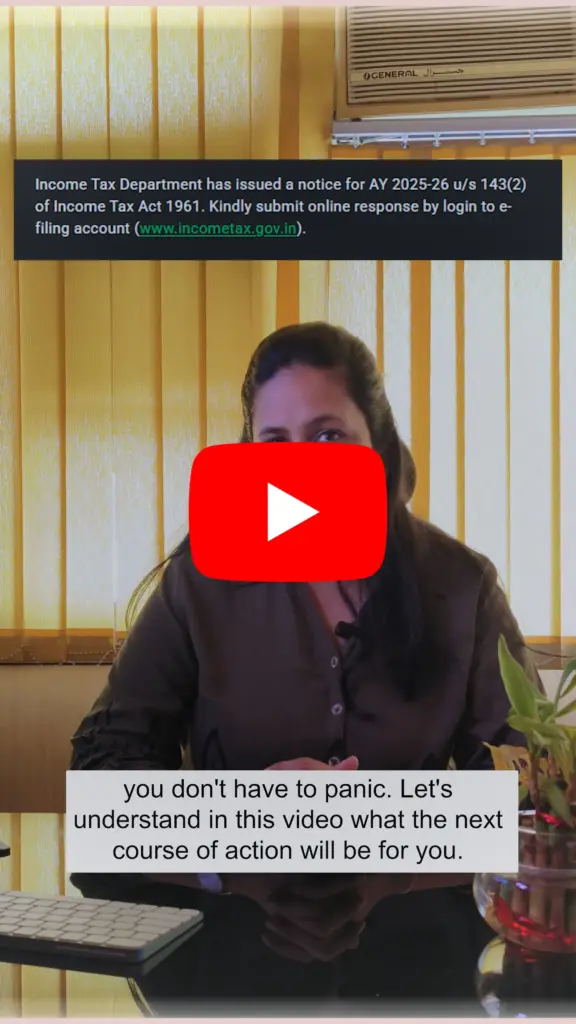
“Income Tax Department has issued a notice for AY 2025-26 u/s 143(2) of Income Tax Act 1961. Kindly submit online response by login to e-filing account (www.incometax.gov.in).”
If you have received this message, there is no need to panic. A notice under Section 143(2) does not mean that a tax demand has been raised against you. It simply means that the Income Tax Department has selected your Income Tax Return (ITR) for scrutiny and requires additional information or supporting documents to verify certain details reported in the return.
Taxpayers are advised to check their e-Filing account regularly and respond within the prescribed timelines to avoid unnecessary penalties and complications.
Watch Our Quick Video Explanation on Section 143(2) Notice
Important Deadline for AY 2025-26
June 30, 2026, is the last date for the Income Tax Department to issue scrutiny notices under Section 143(2) in respect of Income Tax Returns filed during FY 2025-26.
Therefore, taxpayers who have filed their returns should verify their e-Filing account inbox, registered email ID, and mobile notifications to ensure that no important communication is missed.
What is a Notice Under Section 143(2)?
A notice under Section 143(2) of the Income Tax Act, 1961 is issued when the Income Tax Department selects a return for detailed scrutiny assessment.
The objective of scrutiny is to verify:
- Income reported in the return
- Deductions and exemptions claimed
- Capital gains disclosures
- Business or professional income
- Tax credits claimed through TDS/TCS
- Other financial transactions reported to the department
Receiving such a notice is a procedural step and should not automatically be viewed as a sign of wrongdoing.
Why Has Your Return Been Selected for Scrutiny?
The Income Tax Department uses advanced data analytics, AIS, TIS, SFT reporting, GST data, and third-party information to identify cases that require verification.
Some common reasons for scrutiny selection include:
1. Mismatch Between AIS/TIS and Income Reported in ITR
If income reflected in your Annual Information Statement (AIS) or Taxpayer Information Summary (TIS) does not match the income disclosed in your return, your case may be selected for scrutiny.
2. High-Value Financial Transactions
The department closely monitors significant transactions such as:
- Large cash deposits
- Property purchases
- High-value investments
- Substantial credit card spending
Share and mutual fund transactions
3. Foreign Transactions and Remittances
Cases involving foreign remittances, overseas investments, foreign income, or payments made outside India are often examined in greater detail.
4. Significant Variation in Income or Deductions
A sharp increase or decrease in income, unusually high deductions, or substantial losses compared to previous years may attract scrutiny.
5. Large Donations Claimed Under Section 80GGC
Claims involving significant donations under Section 80GGC are frequently reviewed by the department.
6. GST, TDS, TCS, or SFT Mismatches
Differences between information reported through GST returns, TDS statements, TCS records, or Statement of Financial Transactions (SFT) may trigger scrutiny proceedings.
What Should You Do After Receiving a Section 143(2) Notice?
If you have received a scrutiny notice, follow these steps immediately:
Verify the Notice
Log in to your Income Tax e-Filing account and confirm that the notice has been issued by the department.
Understand the Reason for Scrutiny
Carefully review the notice and identify the information or documents being requested.
Gather Supporting Documents
Keep relevant records ready, including:
- Bank statements
- Salary documents
- Investment proofs
- Property documents
- GST records
- Loan statements
- Donation receipts
- Books of accounts and invoices
Submit a Timely Response
Ensure that your response is filed within the time allowed by the department through the e-Filing portal.
Ensure that your response is filed within the time allowed by the department through the e-Filing portal.
Professional guidance can help in preparing an accurate and comprehensive response, especially where complex transactions or substantial tax implications are involved.
Consequences of Ignoring a Section 143(2) Notice
Ignoring an Income Tax notice can lead to serious consequences.
- Penalty Under Section 272A
- A penalty of ₹10,000 may be imposed for each failure to comply with the notice.
Best Judgment Assessment Under Section 144
If no response is furnished, the Assessing Officer may complete the assessment based on available information, which can result in additional tax demands and adverse findings.
Risk of Further Proceedings
Persistent non-compliance may lead to additional legal proceedings under the Income Tax Act.
Key Takeaway
A notice under Section 143(2) should not be ignored, but it should not create panic either. The notice simply provides an opportunity to explain and substantiate the information reported in your Income Tax Return.
Timely action, proper documentation, and a well-prepared response can significantly improve the outcome of scrutiny proceedings and help avoid unnecessary disputes with the tax authorities. If you have received a Section 143(2) notice for AY 2025-26 and need assistance in understanding the notice, preparing documentation, or filing an effective response, our team at Neha R Gupta & Co. can help you navigate the scrutiny assessment process efficiently and ensure complete compliance with the Income Tax Act.
