

Foreign Income in ITR: Common Mistakes NRIs and Residents Should Avoid
Foreign Income in Your Income Tax Return? Avoid These Common Mistakes
Global employment opportunities, overseas investments, foreign bank accounts, and international business activities have made foreign income reporting an important aspect of Income Tax Return (ITR) compliance.
However, many taxpayers are unsure whether their foreign income needs to be reported in India and what disclosures may be required.
Errors in reporting foreign income can lead to compliance issues, inaccurate tax filings, and unnecessary notices. Whether you are a Resident, Non-Resident Indian (NRI), or an individual with cross-border financial interests, understanding the applicable provisions is essential.
In this article, we discuss some of the common mistakes taxpayers make while reporting foreign income in their Income Tax Return.
Understanding Residential Status
Before determining the taxability of foreign income, it is important to determine your residential status under the Income-tax Act.
Residential status plays a significant role in deciding:
- Whether foreign income is taxable in India.
- Which disclosures are required in the Income Tax Return.
- Whether reporting of foreign assets is applicable.
- The scope of income chargeable to tax in India.
Since residential status is determined based on the provisions of the Income-tax Act, taxpayers should carefully evaluate their status for each financial year.
What is Foreign Income?
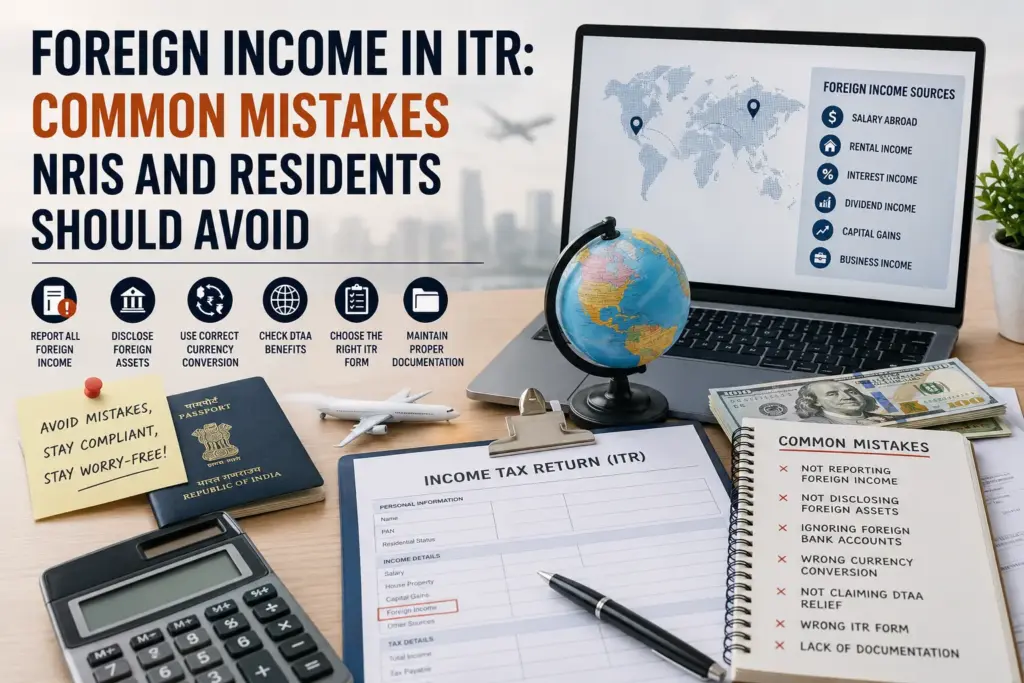
Foreign income may include income earned from sources outside India, such as:
- Salary received for employment abroad.
- Rental income from overseas property.
- Interest earned on foreign bank accounts.
- Dividend income from foreign companies.
- Capital gains from the sale of overseas investments.
- Income from foreign business or professional activities.
- Pension received from another country.
The tax treatment depends upon the taxpayer’s residential status and the applicable provisions of the Income-tax Act.
Common Mistakes Taxpayers Should Avoid
1. Assuming Foreign Income Is Never Taxable in India
One of the biggest misconceptions is that income earned outside India is automatically exempt from taxation in India.
The actual taxability depends on:
- Residential status
- Nature of income
- Applicable provisions of the Income-tax Act
- Relevant Double Taxation Avoidance Agreement (DTAA), wherever applicable
2. Not Reporting Foreign Assets
Many taxpayers incorrectly assume that foreign assets need not be disclosed if they have already paid tax overseas.
Depending on the applicable legal provisions and residential status, reporting requirements relating to foreign assets may apply.
Examples include:
- Foreign bank accounts
- Overseas shares
- Foreign mutual funds
- Property located outside India
- Foreign retirement accounts
3. Ignoring Foreign Bank Interest
Interest earned on overseas bank accounts is often overlooked while preparing the Income Tax Return.
Taxpayers should carefully review all overseas financial accounts and determine the applicable reporting requirements.
4. Incorrect Currency Conversion
Foreign income should generally be converted into Indian Rupees using the applicable method prescribed under the Income-tax Rules.
Using arbitrary exchange rates or bank conversion rates without verifying the prescribed method may result in inaccurate reporting.
5. Not Claiming Relief Under DTAA
India has entered into Double Taxation Avoidance Agreements (DTAAs) with several countries.
Where eligible, taxpayers may be able to claim relief from double taxation subject to the applicable provisions and documentation requirements.
Failure to evaluate DTAA relief may result in higher tax liability.
6. Choosing the Wrong ITR Form
Taxpayers with foreign income or foreign assets should ensure that they select the appropriate Income Tax Return form applicable to their circumstances.
Using an incorrect ITR form may lead to defective return notices or other compliance issues.
7. Not Maintaining Supporting Documents
Taxpayers should preserve documentation relating to:
- Foreign salary statements
- Tax payment certificates
- Bank statements
- Investment statements
- Dividend statements
- Property-related documents
- DTAA-related records, where applicable
Proper documentation helps substantiate disclosures made in the Income Tax Return.
Practical Tips for Taxpayers
- Determine your residential status carefully.
- Maintain records of all foreign income and assets.
- Verify exchange rates using the prescribed rules.
- Review applicable DTAA provisions, where relevant.
- Choose the correct Income Tax Return form.
- File your return within the prescribed timelines.
- Seek professional guidance for complex international tax matters.
Frequently Asked Questions (FAQs)
Is foreign income always taxable in India?
No. The taxability depends on factors such as residential status, the nature of income, and the applicable provisions of the Income-tax Act and relevant tax treaties.
Do NRIs need to report foreign income in India?
The reporting requirements depend on the facts of each case, including residential status and the applicable provisions of law.
What is DTAA?
A Double Taxation Avoidance Agreement (DTAA) is an agreement between two countries intended to reduce the possibility of the same income being taxed twice, subject to the applicable conditions.
Do foreign bank accounts need to be disclosed?
Disclosure requirements depend upon the applicable provisions of the Income-tax Act and the taxpayer’s residential status.
Can foreign tax paid overseas reduce tax liability in India?
Relief may be available in eligible cases under the applicable provisions of the Income-tax Act and relevant DTAA, subject to prescribed conditions.
Conclusion
Foreign income reporting has become increasingly important due to the growing number of taxpayers with overseas employment, investments, and financial interests. Understanding residential status, maintaining proper records, selecting the correct ITR form, and complying with disclosure requirements can help taxpayers avoid common mistakes.
Since tax laws relating to cross-border taxation can be complex and may change over time, taxpayers should always refer to the latest legal provisions, official notifications, and applicable tax treaties before filing their Income Tax Return.
Disclaimer
This article is intended solely for educational and informational purposes and should not be construed as legal, tax, or professional advice. The taxability and reporting of foreign income depend on the facts of each case, residential status, applicable provisions of the Income-tax Act, relevant rules, and Double Taxation Avoidance Agreements (DTAAs). Readers are advised to consult a qualified tax professional before taking any tax-related decisions.
About Neha R Gupta & Co.
Neha R Gupta & Co. is a Chartered Accountancy firm committed to sharing educational insights on taxation, regulatory compliance, and financial matters. Our objective is to help individuals and businesses understand evolving tax laws and make informed compliance decisions.
