

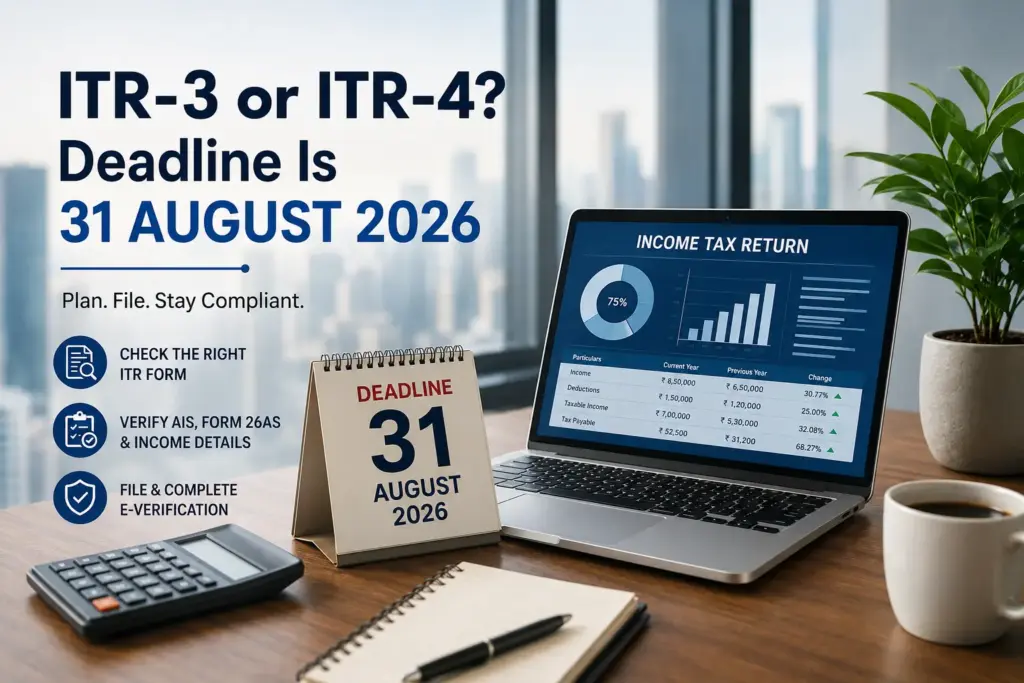
ITR Due Date 2026: Why the Deadline for ITR-3 & ITR-4 Is 31 August
For taxpayers with business or professional income, the income tax return deadline for AY 2026–27 may look different from the familiar 31 July deadline. For eligible non-audit cases, the due date is 31 August 2026. Here’s what taxpayers filing ITR-3 or ITR-4 need to know before filing.
The income tax filing season for Assessment Year (AY) 2026–27 comes with an important change in the filing timeline.
While individuals filing ITR-1 and ITR-2 continue to have the usual 31 July 2026 deadline, the Government has staggered the timeline for certain non-audit business and professional cases, allowing them until 31 August 2026.
This distinction is particularly relevant for taxpayers who may need to file ITR-3 or ITR-4.

What Is the ITR Due Date for AY 2026–27?
For AY 2026–27, taxpayers should not assume that every individual has the same filing deadline.
The broad timeline is:
| Category | Applicable Return | Due Date |
|---|---|---|
| Individuals/HUFs covered by ITR-1 or ITR-2 | ITR-1 / ITR-2 | 31 July 2026 |
| Eligible non-audit business/profession cases | ITR-3 / ITR-4, as applicable | 31 August 2026 |
| Taxpayers subject to audit | Applicable ITR | Later due date as prescribed |
The Income Tax Department’s current guidance states that for AY 2026–27, the due date is 31 July 2026 or 31 August for non-audit cases, as applicable.
For ITR-4 specifically, the Income Tax Department confirms that the due date for AY 2026–27 is 31 August 2026.
Why Has the Deadline Changed to 31 August?
The change was proposed in Budget 2026 as part of a staggered return-filing timeline.
The Finance Minister proposed that individuals filing ITR-1 and ITR-2 would continue to file by 31 July, while non-audit business cases and trusts would be allowed time until 31 August.
This is especially relevant in a year when taxpayers are also dealing with the transition to the Income Tax Act, 2025, which came into effect from 1 April 2026.
However, there is an important point to understand:
AY 2026–27 relates to income earned during FY 2025–26 and continues to be governed by the Income Tax Act, 1961. The new Act applies to the subsequent tax-year framework.
Therefore, taxpayers should not confuse:
- AY 2026–27 → Income earned during FY 2025–26
- Tax Year 2026–27 → Income earned during FY 2026–27
These are separate compliance periods.
Who Should File ITR-3?
ITR-3 is generally applicable to an individual or HUF having income from business or profession who is not eligible to file ITR-1, ITR-2 or ITR-4.
It can cover income from sources such as:
- Salary or pension
- House property
- Business or profession
- Capital gains
- Other sources
The exact applicability depends on the taxpayer’s income profile and circumstances.
For example, a professional with business/professional income who does not satisfy the conditions for ITR-4 may need to file ITR-3.
Who Can File ITR-4?
ITR-4, also known as Sugam, is designed for certain resident individuals, HUFs and firms other than LLPs who meet the prescribed conditions.
For AY 2026–27, the Income Tax Department states that ITR-4 can generally be used where:
- Total income does not exceed ₹50 lakh. However, in cases where more than 95% of the total receipts are received through prescribed electronic/digital modes, the ₹50 lakh limit is extended to ₹75 lakh, subject to the other prescribed conditions for filing ITR-4.
- Business or professional income is computed on a presumptive basis under Section 44AD, 44ADA or 44AE
- Other prescribed eligibility conditions are satisfied
There are also restrictions that can make a taxpayer ineligible for ITR-4, such as certain director status, short-term capital gains, specified foreign assets/income and other conditions.
So, having business income does not automatically mean ITR-4 is the correct form.
The correct ITR depends on the taxpayer’s complete financial profile.
What Should You Check Before Filing?
The extra time until 31 August should not be treated as a reason to postpone filing.
Before submitting your return, review the following:
1. Choose the Correct ITR Form
First determine whether you should file ITR-3, ITR-4 or another applicable return.
Choosing an incorrect form can create unnecessary compliance issues later.
2. Reconcile Your Income
Compare your records with:
- Bank statements
- Books of accounts
- Invoices
- Investment statements
- Salary or professional receipts
- Interest income
- Dividend income
- Capital gains
Make sure all relevant income has been considered.
3. Check Form 26AS and AIS
Your Form 26AS and Annual Information Statement (AIS) can contain information relating to TDS, interest, securities transactions and other reported financial information.
Reconcile these details with your own records before filing.
The Income Tax Department also recommends separately reconciling tax information for the relevant assessment year during the transition between the old and new tax frameworks.
4. Review Tax Regime Selection
Taxpayers with business or professional income need to pay particular attention to the applicable tax-regime requirements.
Where an eligible taxpayer with business income wants to opt out of the default new tax regime and choose the old regime, Form 10-IEA requirements should also be considered within the prescribed timeline.
5. Check Tax Payable
Before filing, calculate whether any additional tax is payable.
This can help avoid last-minute surprises and interest or other consequences arising from unpaid tax.
6. Complete e-Verification
Filing the return is not necessarily the final step.
After submitting the ITR, make sure the return is verified through the prescribed electronic or other permitted mode within the applicable timeline.
The Income Tax Department confirms that electronic verification methods continue to be available for return verification.
What If You Miss the 31 August 2026 Deadline?
Missing the original due date does not necessarily mean that you can no longer file your return.
For AY 2026–27, a belated return may generally be furnished up to 31 December 2026 or before completion of assessment, whichever is earlier, subject to the applicable provisions.
A late-filing fee under Section 234F may also apply:
- ₹1,000 where total income does not exceed ₹5 lakh
- ₹5,000 in other cases
The applicable interest and other consequences should also be evaluated based on the taxpayer’s circumstances.
However, waiting until after the due date can create avoidable complications.
Important: Don’t Confuse ITR-3/ITR-4 With ITR-1/ITR-2
One of the biggest sources of confusion this year is the assumption that 31 August is the deadline for everyone.
It isn’t.
If you are an individual eligible to file ITR-1 or ITR-2, the applicable due date remains 31 July 2026.
The 31 August timeline is relevant to eligible non-audit business/profession cases and other categories covered by the applicable provisions.
Therefore, the first question should always be:
“Which ITR form applies to me?”
Not simply:
“What is the ITR deadline?”
Final Takeaway
The 31 August 2026 deadline gives eligible non-audit business and professional taxpayers additional time to prepare and file their returns for AY 2026–27.
But additional time should be used for accurate compliance—not last-minute filing.
Before filing your ITR-3 or ITR-4:
- Check the correct ITR form
- Reconcile AIS and Form 26AS
- Verify business/professional income
- Review deductions and tax-regime requirements
- Check tax payable
- Keep supporting documents ready
- File before the applicable deadline
- Complete e-verification
A correctly filed return is not just about meeting a deadline—it is about ensuring that the income, taxes and financial information reported to the Income Tax Department accurately reflect your records.
Frequently Asked Questions
Q1. What is the ITR-4 due date for AY 2026–27?
For AY 2026–27, the Income Tax Department states that the due date for filing ITR-4 is 31 August 2026.
Q2. Is 31 August 2026 the deadline for every individual taxpayer?
No. ITR-1 and ITR-2 filers generally continue to have a 31 July 2026 deadline, while eligible non-audit business/profession cases fall under the 31 August timeline.
Q3. Who generally files ITR-3?
ITR-3 is generally applicable to individuals and HUFs having income from business or profession who are not eligible to file ITR-1, ITR-2 or ITR-4.
Q4. Who can file ITR-4?
Eligible resident individuals, HUFs and firms other than LLPs meeting the prescribed conditions, including the relevant presumptive taxation and income limits, may file ITR-4.
Q5. What happens if I miss the 31 August deadline?
A belated return may generally be filed up to 31 December 2026, subject to the applicable provisions, and late-filing fees and other consequences may apply.
Q6. Is AY 2026–27 governed by the new Income Tax Act, 2025?
No. AY 2026–27 relates to FY 2025–26 and remains governed by the Income Tax Act, 1961. The new Act applies to the subsequent tax-year framework beginning from 1 April 2026.
Disclaimer: This article is intended for general informational purposes only and does not constitute professional tax, legal or financial advice. Tax provisions, forms, deadlines and compliance requirements may change based on legislation, notifications and individual circumstances. Taxpayers should review the latest official guidance and seek professional advice where appropriate.
