
Presumptive Taxation for Freelancers and Consultants (AY 2026-27): Part 2
In Part 1 of this guide, we covered the basics of ITR filing for freelancers and consultants in India. In this second part, we take a closer look at one of the most useful tax provisions available to professionals: the presumptive taxation scheme under Section 44ADA. This scheme can significantly reduce the compliance burden for eligible freelancers and consultants, and understanding how it works is essential before deciding whether to opt in.
What Is Presumptive Taxation?
Presumptive taxation allows certain taxpayers to declare a fixed percentage of their gross receipts as taxable income, instead of maintaining detailed books of accounts and computing actual profit.
The Income Tax Act provides for this scheme under Section 44ADA for specified professionals, alongside separate provisions for small businesses (Section 44AD) and transporters (Section 44AE).
Who Can Opt for Section 44ADA?
Section 44ADA is available to resident individuals and partnership firms (excluding LLPs) engaged in a profession notified under Section 44AA(1) of the Income Tax Act.
This includes:
- Legal professionals (lawyers, advocates)
- Medical professionals (doctors, dentists)
- Engineers and architects
- Chartered Accountants, Company Secretaries, and Cost Accountants
- Technical consultants and interior designers
- IT professionals and software developers (notified professions)
- Film artists and certain other notified professionals
Note: Freelancers whose work does not fall under a notified profession, such as digital marketers or content creators, are generally not eligible for Section 44ADA and may need to consider Section 44AD instead, subject to its own conditions.
Turnover Limits for AY 2026-27
For AY 2026-27 (FY 2025-26), the gross receipts limit under Section 44ADA is:
- Up to ₹50 lakh in a financial year, or
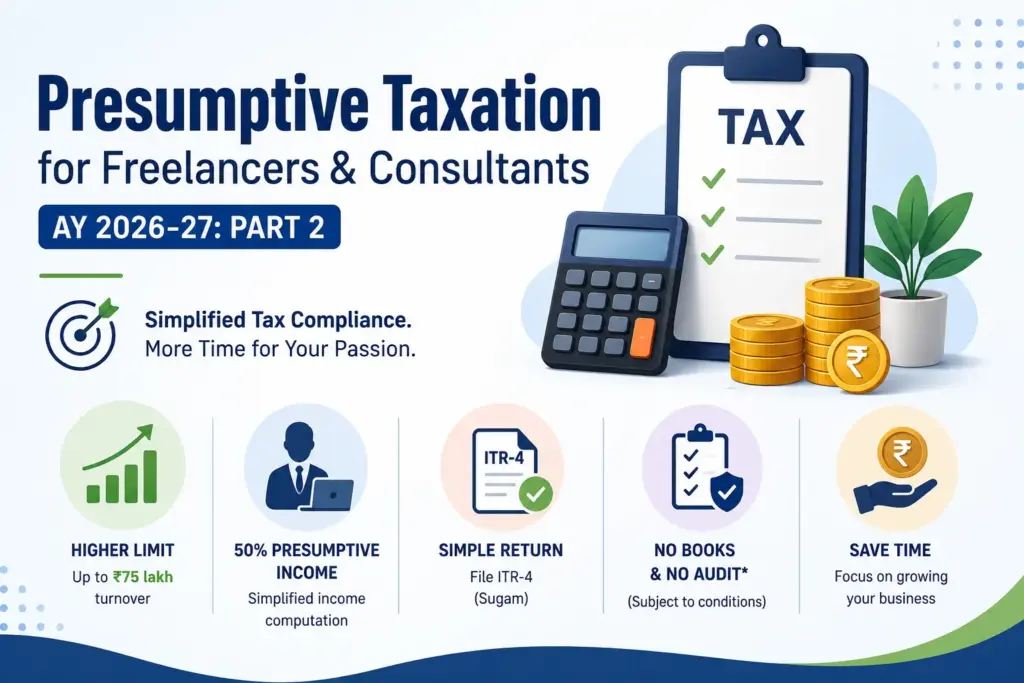
- Up to ₹75 lakh, if at least 95% of receipts are received through banking channels such as UPI, NEFT, RTGS, account payee cheques, or other digital modes, meaning cash receipts do not exceed 5% of total receipts.
If gross receipts exceed the applicable limit, the professional cannot use Section 44ADA for that year and must file returns under the regular provisions instead.
How the 50% Presumptive Income Rule Works
Under Section 44ADA, a professional can declare 50% (or more) of gross receipts as taxable income, and the remaining 50% is deemed to cover all business expenses.
No separate deductions for expenses such as rent, salaries, or depreciation can be claimed once this scheme is chosen.
A professional may voluntarily declare a higher percentage than 50% if actual profits are higher, but declaring less than 50% brings the tax audit provisions into play if total income exceeds the basic exemption limit.
Example: A freelance architect earns gross receipts of ₹40 lakh in FY 2025-26. Under Section 44ADA, 50% of ₹40 lakh, i.e. ₹20 lakh, is treated as taxable professional income. Tax is computed on this ₹20 lakh as per the applicable slab rates, without needing to justify individual expenses.
Which ITR Form to File
Professionals opting for Section 44ADA generally file ITR-4 (Sugam), which is designed for taxpayers using presumptive taxation under Sections 44AD, 44ADA, or 44AE.
However, ITR-3 becomes necessary instead of ITR-4 if the professional also has capital gains income, owns more than one house property, has foreign income or assets, or is a partner in a firm outside the presumptive scheme.
Benefits of Opting for Section 44ADA
- No requirement to maintain detailed books of accounts for the professional income
- No tax audit required, provided receipts are within the limit and 50% or more income is declared
- Simplified return filing through ITR-4
- Only one advance tax instalment is required, rather than the usual four
- Chapter VI-A deductions such as 80C and 80D can still be claimed on the presumptive income
Points to Keep in Mind
- Gross receipts must include all professional fees billed, not just amounts received after TDS deduction
- GST collected from clients should not be included while computing gross receipts
- Section 44ADA does not have a five-year lock-in like Section 44AD; a professional can move in and out of the scheme year to year based on their situation
- 100% of advance tax liability must be paid on or before 15 March of the financial year; missing this can attract interest under Sections 234B and 234C
- If actual expenses are significantly higher than 50% of receipts, the presumptive scheme may result in paying tax on income higher than actual profit
Is Section 44ADA Right for You?
Section 44ADA works well for professionals whose actual profit margin is close to or above 50% of receipts, and who want to avoid the compliance burden of maintaining detailed books and undergoing an audit.
However, professionals with high genuine business expenses, such as significant equipment costs, office rent, or staff salaries, may find that the regular computation of income under ITR-3 results in lower tax liability.
It is advisable to compute your tax liability both ways before deciding which route to opt for in a given year.
Conclusion
Section 44ADA offers a simplified route to tax compliance for eligible freelancers and consultants, but it is not automatically the most tax-efficient choice for everyone.
Understanding the eligibility conditions, turnover limits, and trade-offs discussed in this guide will help you make an informed decision for AY 2026-27.
This guide has been prepared by Neha R Gupta & Co., an ICAI-registered Chartered Accountancy firm based in Delhi and Gurgaon, practising in the areas of income tax, GST, and related compliance.
