

CBDT’s Foreign Remittance Crackdown: Why Form 15CB Due Diligence Matters More Than Ever
Foreign remittances are coming under sharper tax scrutiny. With the Income Tax Department initiating verification of suspicious outward remittances involving around 394 entities and 36 professionals, the focus is not limited to taxpayers alone. Chartered Accountants issuing tax-determination certificates are also being examined.
The development is an important reminder that Form 15CB is not merely a procedural document. It involves professional examination of the taxability of a foreign remittance, applicable withholding tax and relevant provisions of domestic tax law and tax treaties.
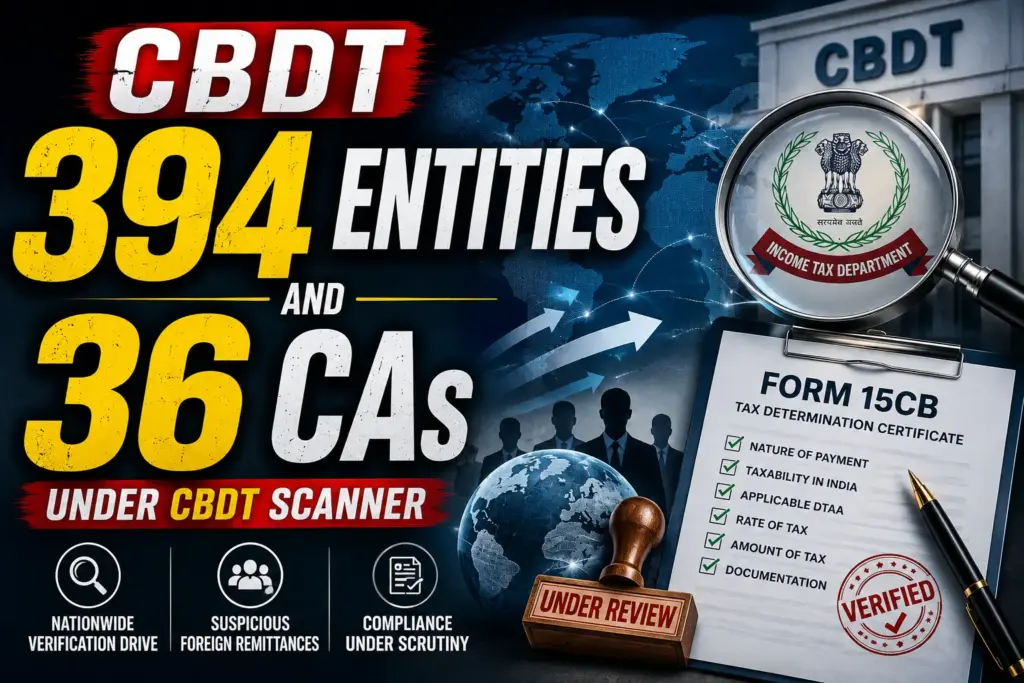
CBDT Initiates Verification of Suspicious Foreign Remittances
On 18 August 2026, the Income Tax Department announced a nationwide verification exercise concerning suspicious foreign remittances.
According to the Department, its analysis of outward remittance data and ground intelligence identified entities that had remitted substantial amounts of money overseas despite reporting very low turnover or limited business activity.
The exercise covers approximately 394 entities, including 117 entities located in States along India’s land borders, and 36 professionals associated with Form 15CB certifications. Further investigation is underway.
The Department’s concerns reportedly include cases where:
- The amount remitted abroad appeared disproportionate to the entity’s reported turnover.
- The stated purpose of the remittance did not appear consistent with the entity’s business activities.
- Some entities were non-filers or reported very small income.
- Certain entities were reportedly not operating from their declared addresses.
- A relatively small group of professionals had issued Form 15CB certificates for multiple entities.
The broader message is clear: foreign remittances are increasingly being examined through data analytics, and unusual transaction patterns can attract regulatory attention.
What Was Form 15CB?
Under the Income-tax Act, 1961 framework, Form 15CB is a certificate issued by a Chartered Accountant in specified cases involving taxable payments to a non-resident or a foreign company.
The CA examines the nature of the remittance and determines matters such as:
- Whether the payment is chargeable to tax in India;
- The applicable provisions of the Income-tax Act;
- The relevant provisions of a Double Taxation Avoidance Agreement (DTAA), where applicable;
- The appropriate rate of tax deduction;
- The amount of tax required to be deducted; and
- Other relevant particulars of the remittance.
The Income Tax Department describes Form 15CB as a Tax Determination Certificate in which the CA examines the remittance with reference to its taxability.
Form 15CB and Form 15CA: How Are They Connected?
Form 15CA is the declaration furnished by the person making the foreign remittance, while Form 15CB is the CA’s certificate in cases where the prescribed conditions for certification are satisfied.
For example, under the earlier framework, Form 15CA was divided into different parts depending on the nature and taxability of the remittance.
Part C of Form 15CA was relevant where:
- The remittance was chargeable to tax;
- The amount or aggregate amount exceeded ₹5 lakh during the financial year; and
- A Form 15CB certificate had been obtained from a Chartered Accountant.
The Income Tax Department’s guidance confirms that Form 15CB had to be uploaded before filing Form 15CA Part C in applicable cases.
What Has Changed From 1 April 2026?
The tax-form framework has changed with the implementation of the Income-tax Act, 2025.
The earlier Form 15CA corresponds to Form 145, while the earlier Form 15CB corresponds to Form 146 under the new framework. The Income Tax Department’s official mapping guide confirms this transition.
Therefore, while people may continue to use the familiar terms “Form 15CA” and “Form 15CB” in professional discussions, practitioners should also be familiar with their corresponding forms under the new law.
For foreign remittance compliance, the important point remains the same: the tax implications of an overseas payment must be properly examined before the remittance is made.
Why the Current CBDT Action Matters to Chartered Accountants
The latest verification exercise highlights an important professional responsibility.
A Form 15CB certificate should not be treated as a document that can simply be prepared based on information supplied by the client.
Before certifying a transaction, a CA may need to examine the underlying facts and supporting documents, depending on the circumstances.
This can include:
1. Understanding the Nature of Payment
The first question should be:
What exactly is the taxpayer paying for?
For example, the payment could relate to:
- Import of software;
- Professional or consultancy services;
- Freight or logistics;
- Royalty;
- Technical services;
- Interest;
- Commission;
- Subscription or digital services; or
- Other payments to overseas parties.
The tax treatment can differ substantially depending on the actual nature of the payment.
2. Checking the Commercial Substance
The transaction should make commercial sense in the context of the taxpayer’s business.
A large overseas payment by an entity with minimal turnover or little apparent business activity could warrant additional questions and documentation.
The current CBDT verification exercise specifically highlights the importance of identifying inconsistencies between the reported business profile and the value or purpose of foreign remittances.
3. Examining Supporting Documents
Depending on the transaction, relevant documentation could include:
- Agreements or contracts;
- Invoices;
- Purchase orders;
- Import documentation;
- Service agreements;
- Bank statements;
- Accounting records;
- Tax invoices;
- Correspondence with the overseas party; and
- Other documents supporting the commercial purpose of the transaction.
The exact documents required will depend on the facts of each case.
4. Determining Taxability
The CA needs to analyse whether the payment is taxable in India under the applicable provisions.
This may involve examining concepts such as:
- Income deemed to accrue or arise in India;
- Royalty;
- Fees for technical services;
- Business income;
- Interest;
- Permanent Establishment;
- Source-based taxation; and
- Other relevant provisions.
5. Considering the DTAA
Where the recipient is located in a country with which India has a tax treaty, the DTAA may become relevant.
However, treaty benefits should not be assumed merely because the recipient is located outside India.
The applicable treaty provisions, documentation and factual circumstances need to be considered before determining the withholding position.
Red Flags That Should Not Be Ignored
The current verification exercise provides a useful reminder for professionals dealing with foreign remittances.
Some circumstances that may warrant enhanced scrutiny include:
High-value remittance + very low turnover
A business reporting modest revenue but making very large overseas payments should raise questions about the underlying transaction.
Unclear purpose of payment
If the client cannot clearly explain why the payment is being made or what service/goods are being received, further verification may be necessary.
Mismatch between business activity and remittance
A payment should be reasonably connected with the taxpayer’s stated business and actual activities.
Inadequate documentation
A certificate should not be issued merely because an invoice has been provided if the surrounding facts remain unclear.
Repeated certificates for questionable transactions
A pattern of similar transactions involving multiple entities or recipients can warrant additional professional scrutiny.
Unusual recipient arrangements
Payments involving unfamiliar overseas parties, complex structures or unclear commercial relationships may require closer examination.
These are not automatically indicators of wrongdoing. However, they can be signals for additional due diligence.
Why “Client Said So” Is Not Enough
One of the biggest lessons from the current development is the importance of professional judgment.
A CA is not expected to independently investigate every commercial transaction as an enforcement agency. However, certification does involve applying professional judgment to the information and documents available.
If the information provided by the client appears incomplete, contradictory or commercially implausible, simply accepting it without further questions can create professional risk.
The objective should therefore be:
Understand → Verify → Analyse → Document → Certify
rather than:
Receive documents → Fill form → Sign → Submit
Documentation Is Your First Line of Defence
For professionals issuing foreign-remittance certificates, maintaining a proper working-paper trail is extremely important.
The file should, as appropriate to the engagement, demonstrate:
- What information was received from the client;
- What documents were examined;
- How the nature of the payment was determined;
- How taxability was analysed;
- Whether a DTAA was considered;
- How the withholding-tax rate was determined;
- What assumptions were made;
- What clarifications were obtained; and
- The basis on which the certificate was ultimately issued.
Good documentation does not merely help during an assessment or verification. It also demonstrates that the professional exercised appropriate care and judgment when issuing the certificate.
What Should Businesses Do Before Making Foreign Remittances?
The compliance responsibility is not limited to the CA.
Businesses and other remitters should also maintain proper documentation for overseas payments.
Before making a significant foreign remittance, the taxpayer should ideally ensure that:
- The commercial purpose of the payment is clearly documented.
- The agreement/invoice supports the transaction.
- The recipient’s details are accurate.
- The taxability of the payment has been evaluated.
- The applicable withholding tax has been determined.
- Required forms are completed before the remittance.
- Supporting documents are retained for future reference.
Form 15CA is required in specified cases before making the remittance, and the relevant part depends on the nature and taxability of the payment.
The Bigger Picture: Data-Driven Tax Compliance
The latest CBDT action also reflects a broader change in India’s tax administration.
Foreign remittance information can be analysed alongside other financial and tax data.
This means the Department may identify patterns such as:
Low turnover → High outward remittance → Repeated transactions → Similar recipients → Multiple certificates
Such patterns can lead to further verification.
For businesses involved in international transactions, this makes accurate accounting, proper documentation and correct withholding-tax compliance increasingly important.
Key Takeaway for CAs and Businesses
The Form 15CB episode is not simply about one verification exercise.
It reinforces a larger principle:
A tax certificate is a professional conclusion, not a routine formality.
For Chartered Accountants, the focus should be on appropriate due diligence, professional skepticism and adequate documentation.
For businesses, the focus should be on genuine transactions, proper records and correct tax compliance before sending money overseas.
With the transition from the old Form 15CA/15CB framework to Form 145/Form 146 under the Income-tax Act, 2025, professionals and taxpayers should also ensure that their processes are updated to reflect the new framework.
The message from the latest CBDT action is therefore worth taking seriously:
Foreign remittance compliance is no longer just about completing a form. It is about being able to explain, support and defend the transaction.
Disclaimer
This article is intended for general informational and educational purposes only and should not be treated as professional or legal advice. The applicability of tax provisions, withholding requirements, treaty provisions and prescribed forms depends on the facts and circumstances of each transaction. Taxpayers and professionals should refer to the applicable law, rules, notifications and official guidance before taking any compliance decision.
